Abstract
SelExNet is a self-supervised framework for 2D spatially selective excitation that jointly optimizes radiofrequency (RF) pulses and gradient waveforms, with extension to multi-channel transmission MRI. It couples neural RF and gradient generators with a differentiable Bloch simulator, enabling pulse optimization directly from desired excitation outcomes without requiring pre-designed target pulses.
The framework designs RF pulses and parameterized variable-density spiral gradient waveforms for both single- (sTx) and multi-channel (pTx) transmission, and supports patient-specific adaptation using measured, previously unseen B0 and B1+ maps. Joint RF-Gradient optimization improves excitation fidelity over RF-only optimization. In phantom experiments, patient-specific fine-tuning restores target geometry and uniformity under field inhomogeneity. In-vivo studies demonstrate anatomically precise excitation, sharper target boundaries, and reduced off-target signal.
Network Overview
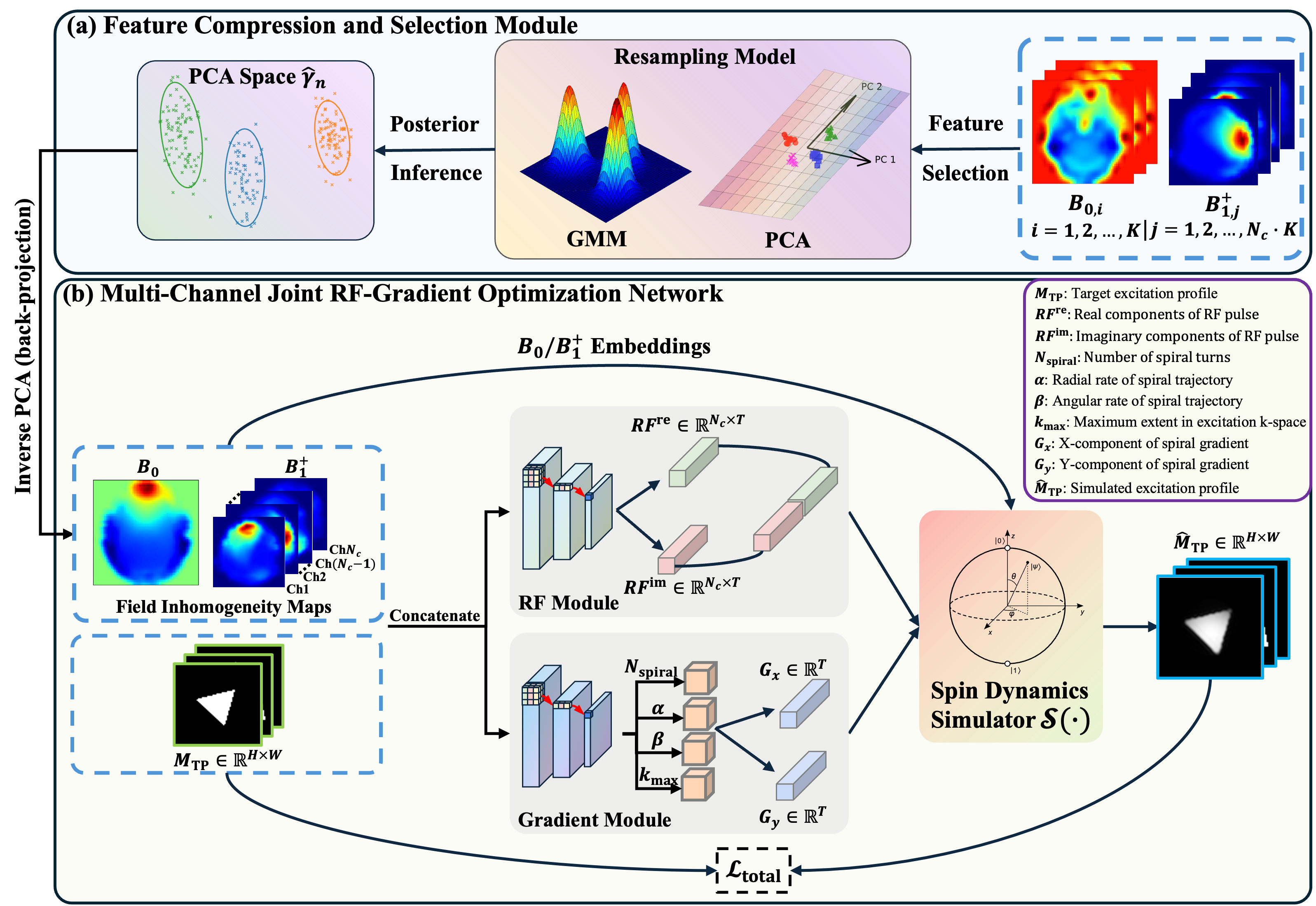
SelExNet uses a Feature Compression and Selection Module to model plausible B0/B1+ field configurations with PCA and Gaussian mixture modeling. The RF module produces complex-valued RF waveforms for each transmit channel, while the gradient module predicts a small set of parameters for a variable-density spiral trajectory, including the number of spiral turns, radial and angular rates, and maximum excitation k-space extent.
Generated RF and gradient waveforms are passed through a differentiable Bloch simulator. The loss combines profile fidelity terms, RF amplitude and smoothness regularization, gradient amplitude and slew-rate constraints, and weight decay. Minute-scale patient-specific transfer learning fine-tunes the pretrained model using measured field maps, providing fast adaptation to individual field inhomogeneity conditions.
Experimental Results
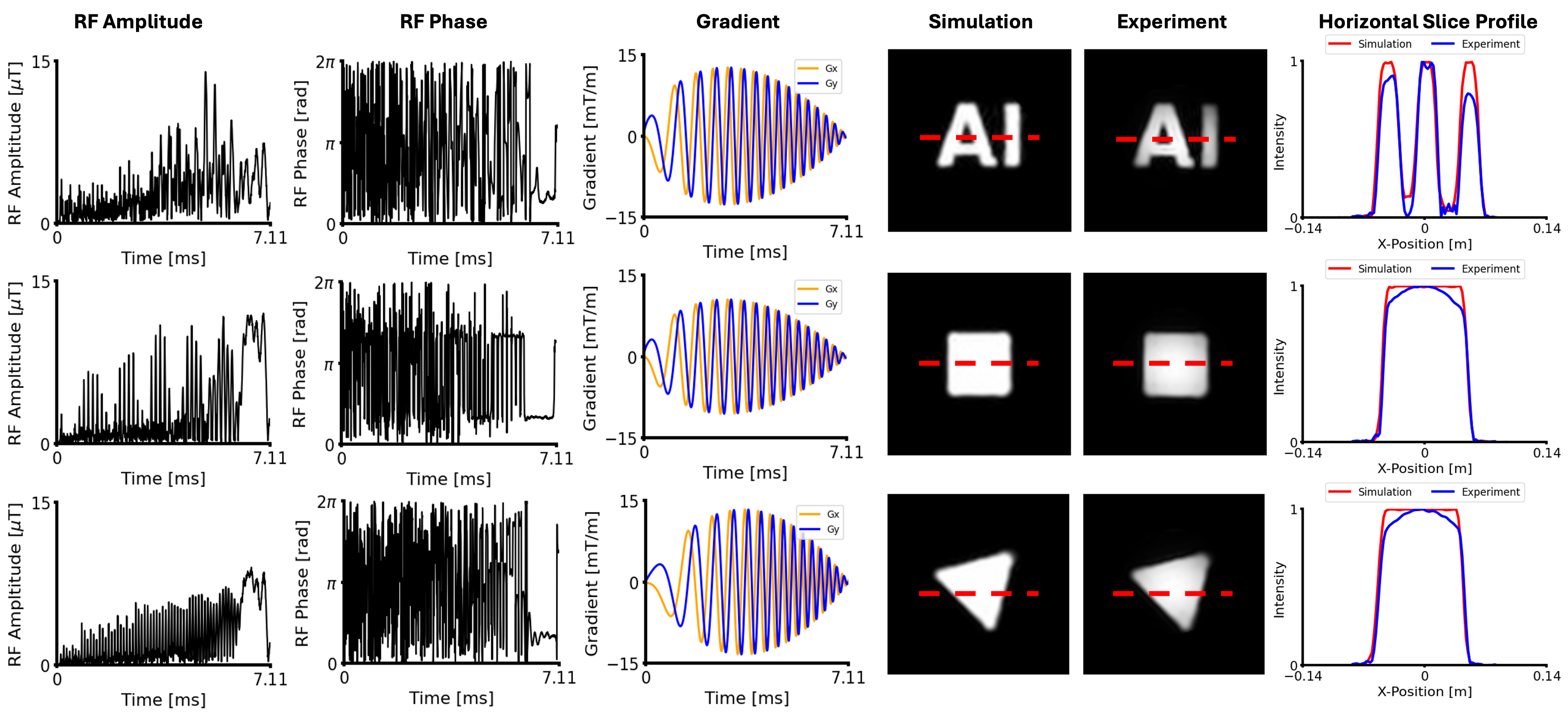
Representative phantom results using SelExNet in the sTx configuration (Nc = 1) under ideal conditions without pronounced B0/B1+ inhomogeneities. Representative excitation patterns for letter, square, and triangular targets demonstrate accurate geometry reproduction with minimal background excitation.
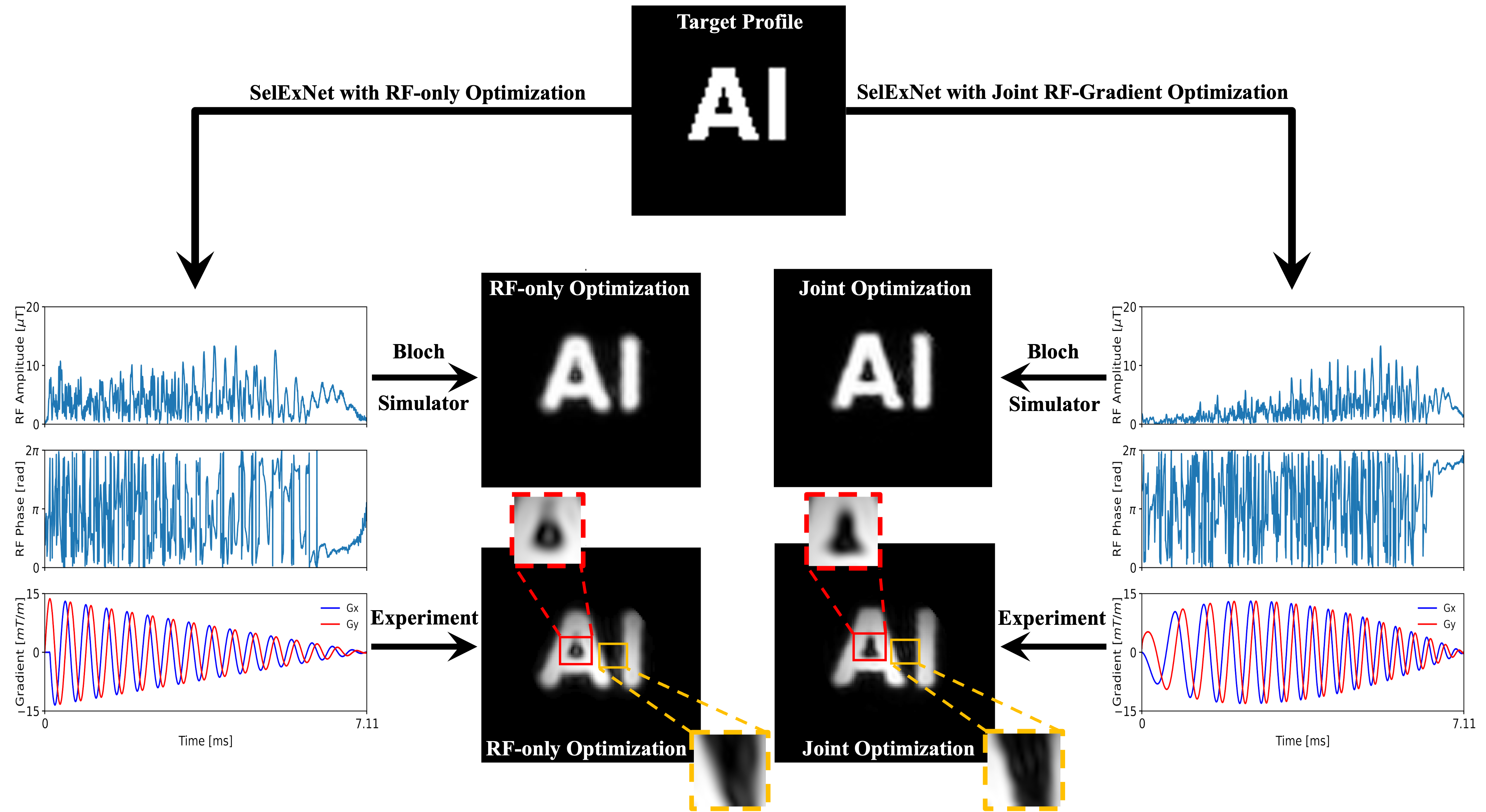
Qualitative comparison of RF-only optimization and joint RF-Gradient optimization for the "AI" target with SelExNet under sTx conditions and ideal fields for MRI experiments in a uniform phantom.
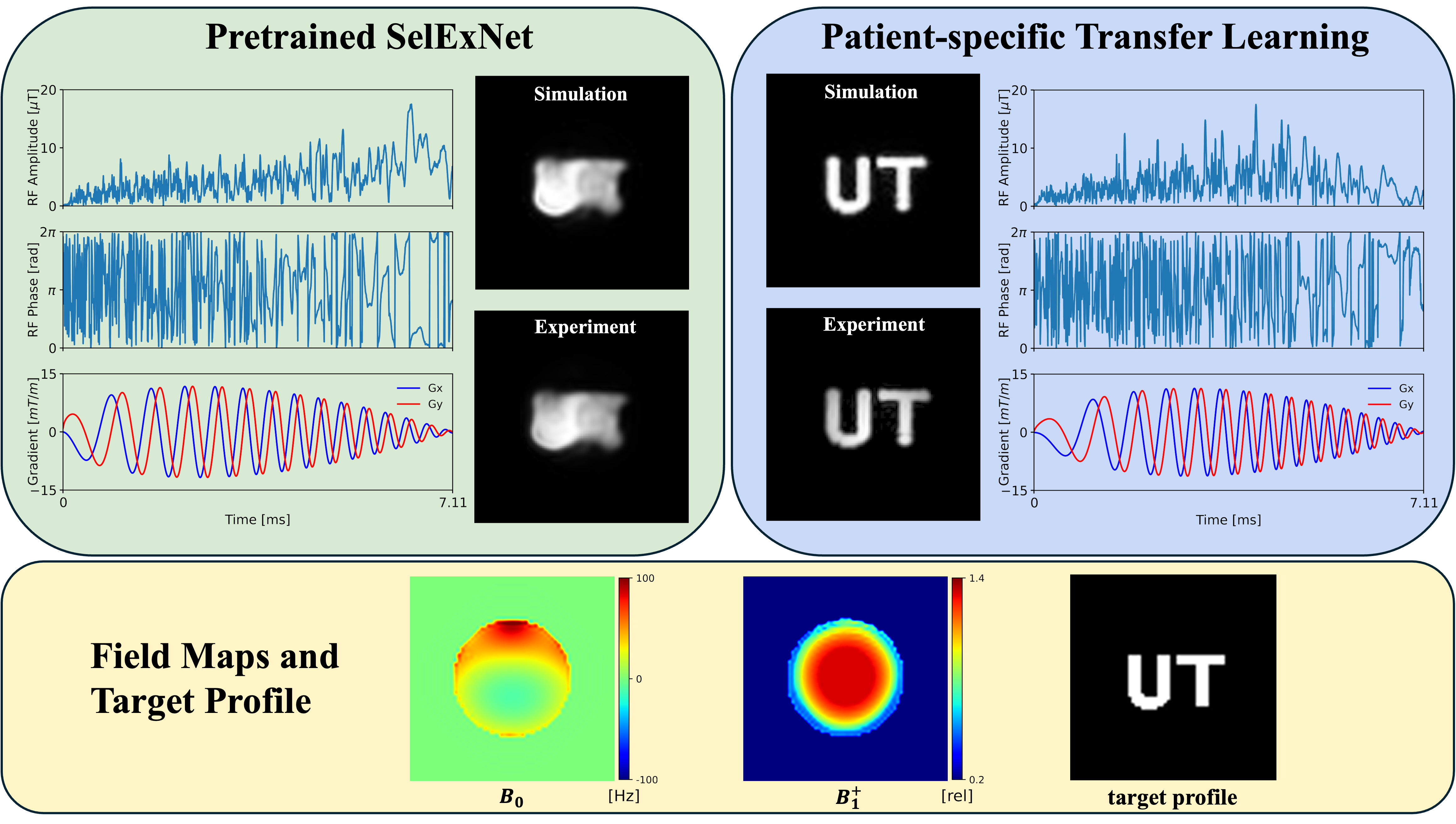
Patient-specific transfer learning restores UT geometry and uniformity under previously unseen B0/B1+ inhomogeneity.
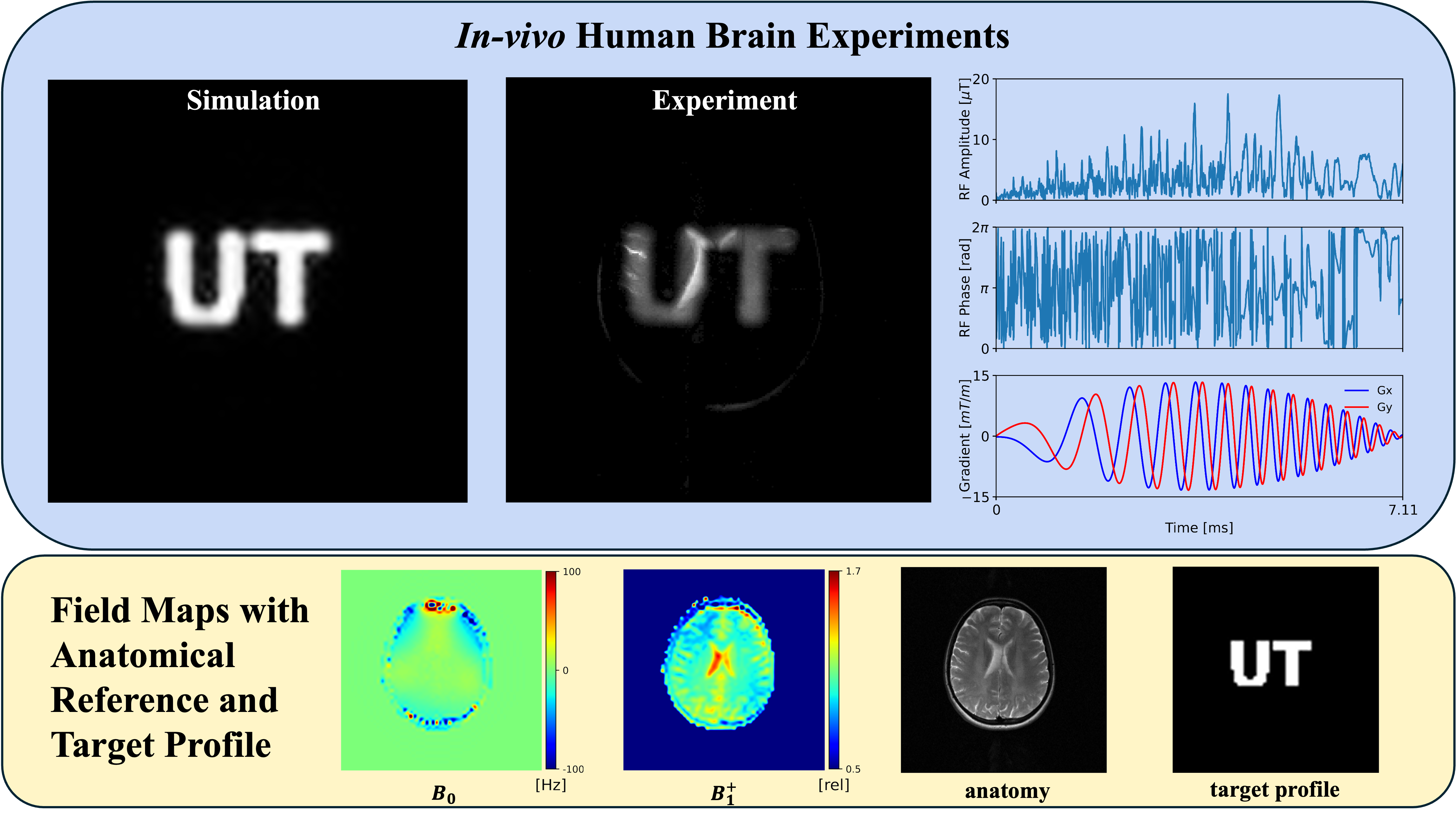
In-vivo sTx brain experiments show close agreement between simulated and measured "UT" excitation under patient-specific field maps.
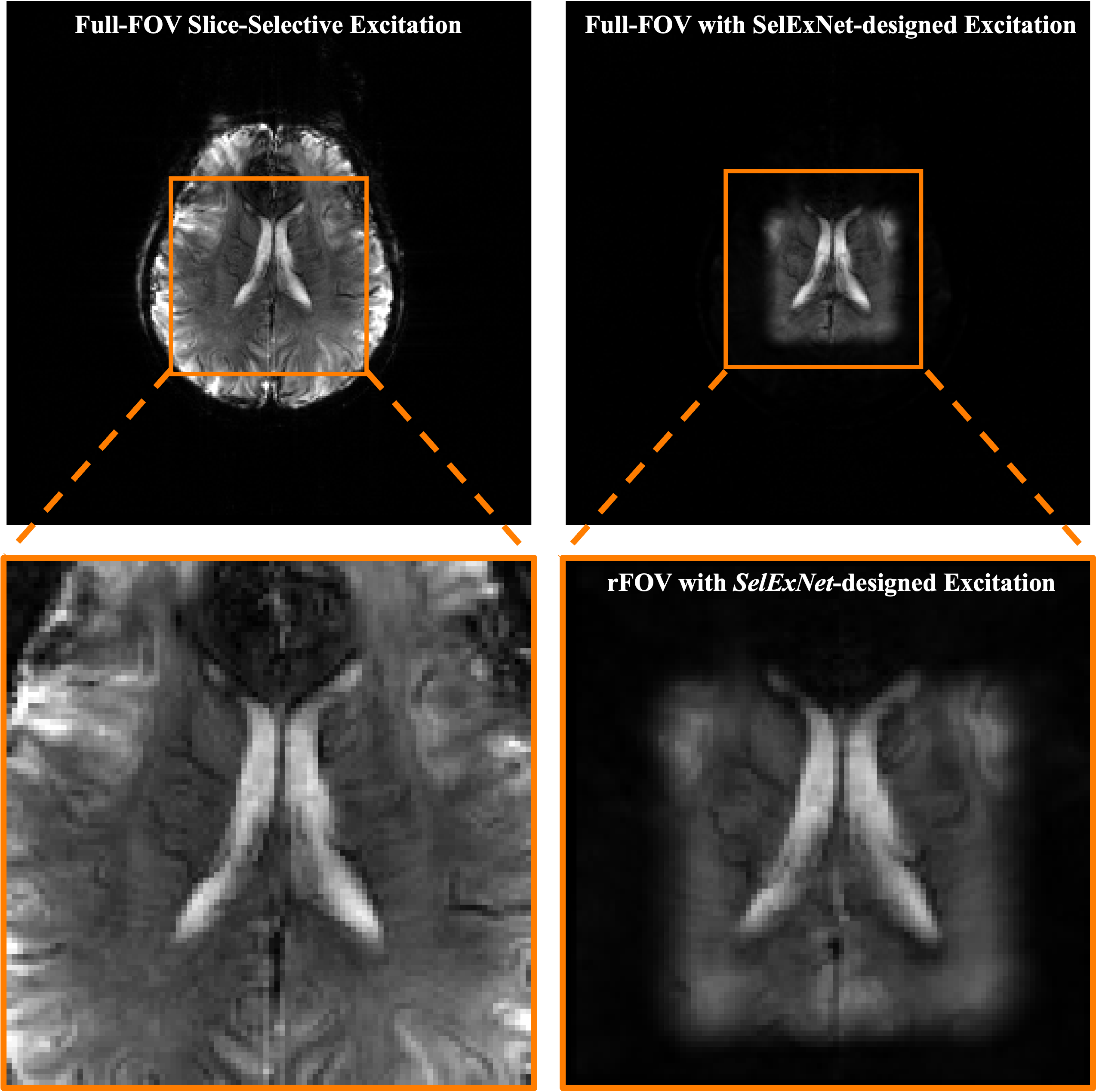
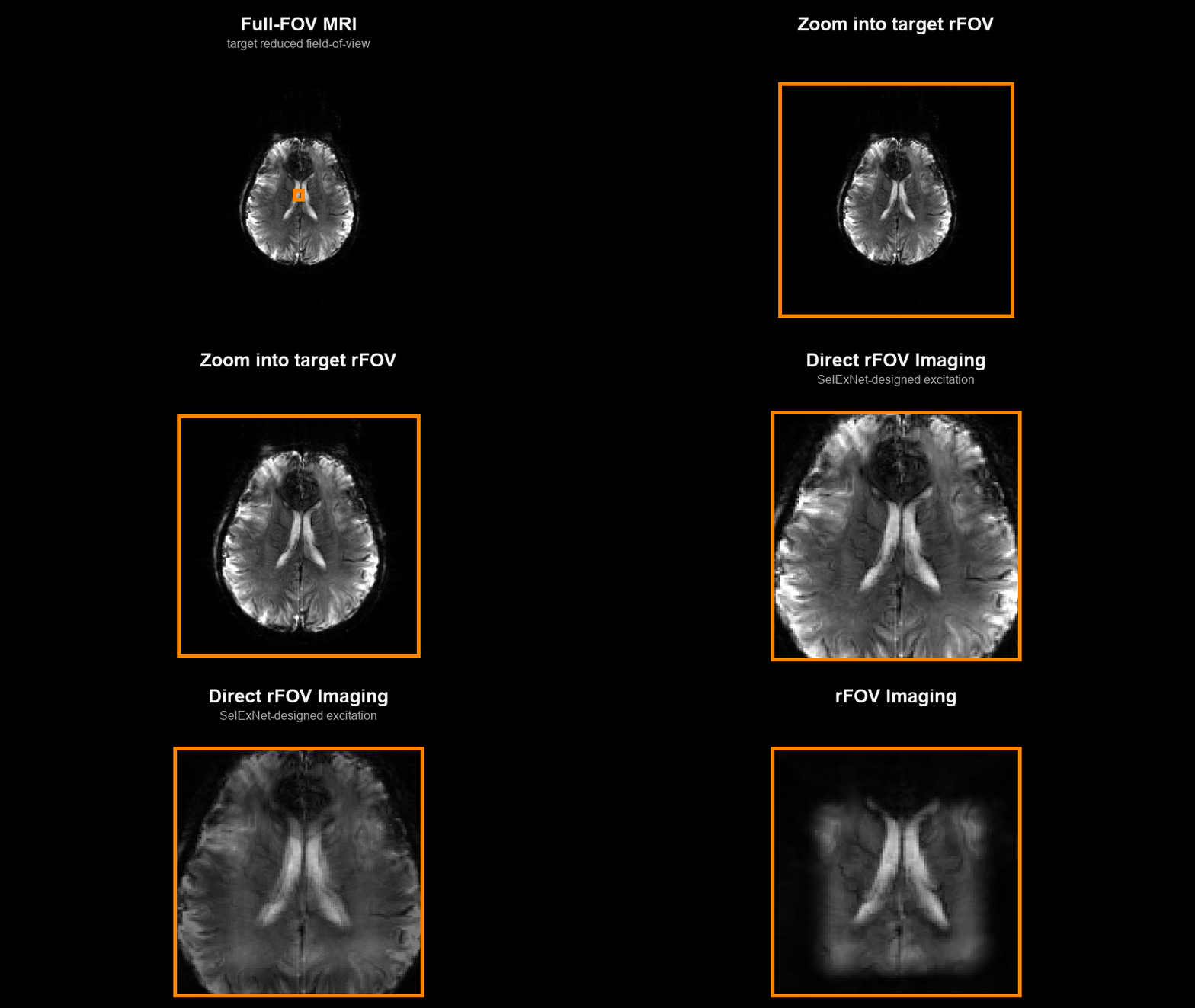
At 7T, SelExNet-designed pTx excitation confines signal to the prescribed rFOV while preserving anatomical detail.
Quantitative Evaluation
| Method | SSIM ↑ | PSNR (dB) ↑ | NRMSE ↓ | BSR ↓ |
|---|---|---|---|---|
| Single-channel Transmission | ||||
| GPS-RF | 0.681 | 24.9 | 0.065 | 0.045 |
| SelExNet-RF-Only | 0.937 | 26.2 | 0.053 | 0.016 |
| SelExNet-Joint | 0.956 | 27.6 | 0.042 | 0.012 |
| Multi-channel Transmission | ||||
| Vendor-provided demo pTx | 0.613 | 18.6 | 0.182 | 0.157 |
| SelExNet-Joint | 0.964 | 28.5 | 0.037 | 0.007 |
BSR is the background-to-signal ratio. Lower BSR indicates stronger suppression of excitation outside the target ROI.
Accepted Abstract
BibTeX
@article{xiao2026selexnet,
  title={SelExNet: A Self-Supervised Physics-Informed Framework for Multi-Channel Joint RF and Gradient Waveform Optimization in 2D Spatially Selective Excitation},
  author={Xiao, Yuliang and Rock, Jason and Wu, Zhe and Near, Jamie and Chiew, Mark and Graham, Simon J.},
  journal={Magnetic Resonance in Medicine},
  volume = {96},
  number = {3},
  pages = {1219-1234},
  year={2026}
}